
TURN RISK INTO EARLY ACTION.
NOT LATE EXPLANATIONS.
Earlier signals. Stronger decisions. Controlled project outcomes.
Complex projects rarely fail without warning. The signals exist, but they are often fragmented across schedules, reports, interfaces, contracts and stakeholder decisions.
PMCC combines deep project-delivery expertise with AI-enabled risk intelligence to identify emerging threats earlier, assess potential consequences, detect patterns and support faster, better-informed decisions.
Our approach integrates experienced professional judgement with structured risk processes aligned to ISO 31000:2018and PMI’s Risk Management in Portfolios, Programs, and Projects: A Practice Guide. ISO 31000 remains the current published edition, while PMI’s updated 2024 guide provides practical risk-management application across portfolios, programmes and projects.
Through our Expert in the Loop™ methodology, AI accelerates analysis and visibility, while PMCC specialists validate findings, challenge assumptions, assign ownership and ensure that every response remains practical, traceable and accountable.
What is Risk Management?
Risk Management is how organisations bring structure, visibility, and control to uncertainty.
It enables project teams to identify what could affect their objectives, understand the possible causes and consequences, assess the level of exposure, and define appropriate actions before risks become project issues. When implemented effectively, Risk Management becomes more than a register. It becomes a decision-making discipline that supports governance, accountability, and delivery confidence.
PMCC’s approach is aligned with ISO 31000:2018, which frames risk management around principles, a framework, and a process for managing risk across different organisational and project contexts.
For complex infrastructure and railway projects, this means risks are identified, assessed, treated, monitored, reviewed, and reported in a way that supports clearer decisions and stronger project control.
Why Risk Management Matters
A design delay may become an interface issue. An interface issue may affect testing readiness. A testing constraint may become a commissioning risk. A commissioning risk may affect safety assurance, operational readiness, stakeholder acceptance, or handover.
Without a structured approach, risks are discovered late, ownership becomes unclear, and project teams are forced into reactive decision-making. The result is often avoidable delay, unmanaged escalation, weak evidence, and reduced confidence at the point where control matters most.
Effective Risk Management changes this.
It gives project teams a disciplined way to see uncertainty earlier, understand what matters most, assign responsibility, monitor treatment actions, and make decisions based on evidence rather than assumption.
For clients, this means stronger governance, better visibility, and greater confidence that project risks are being actively controlled.
Our ISO 31000:2018-Aligned Approach
PMCC applies a structured approach to Risk Management based on the intent of ISO 31000:2018: risk management should be integrated, systematic, transparent, responsive, and connected to decision-making.
We support clients through a practical risk management process that can be adapted to the project, organisation, delivery phase, and governance environment.
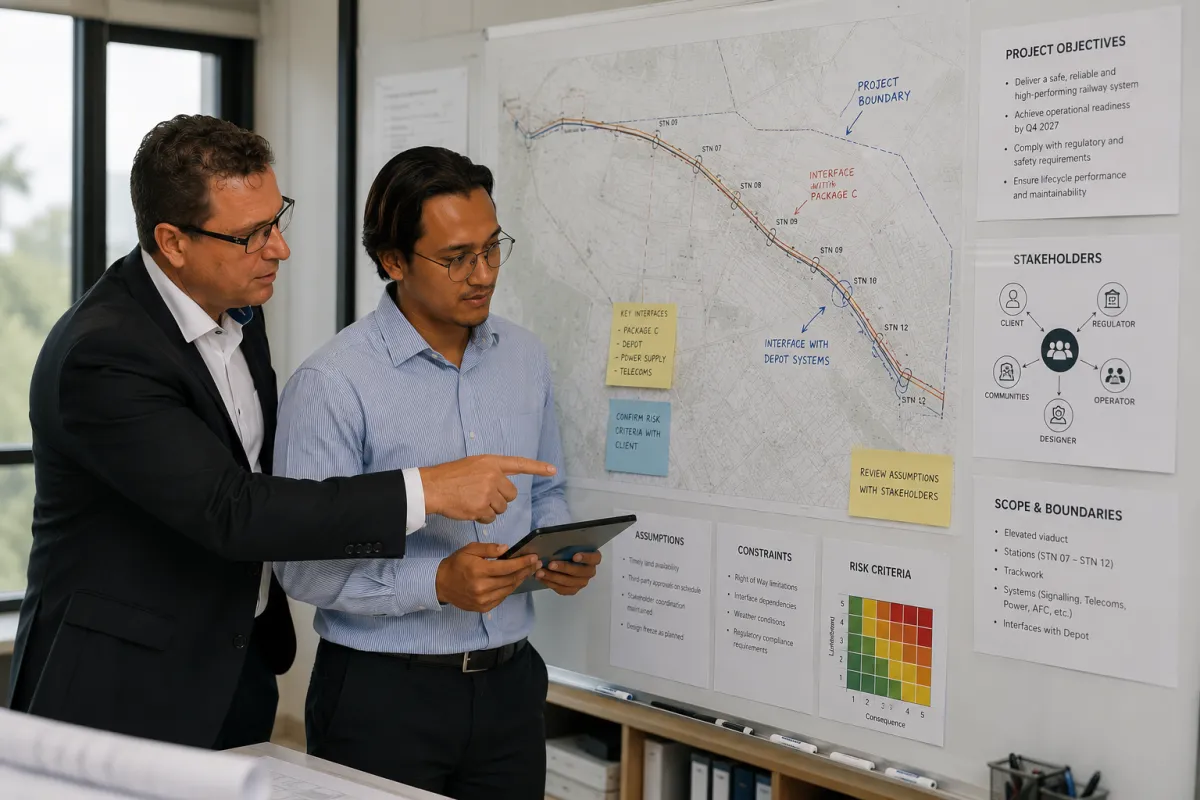
1. Establish the Context
We define the project environment, objectives, stakeholders, assumptions, constraints, risk criteria, and governance expectations.
This creates a clear basis for assessing risk consistently across disciplines, packages, systems, interfaces, and delivery stages.
Outcome: A Clear Foundation for Better Decisions
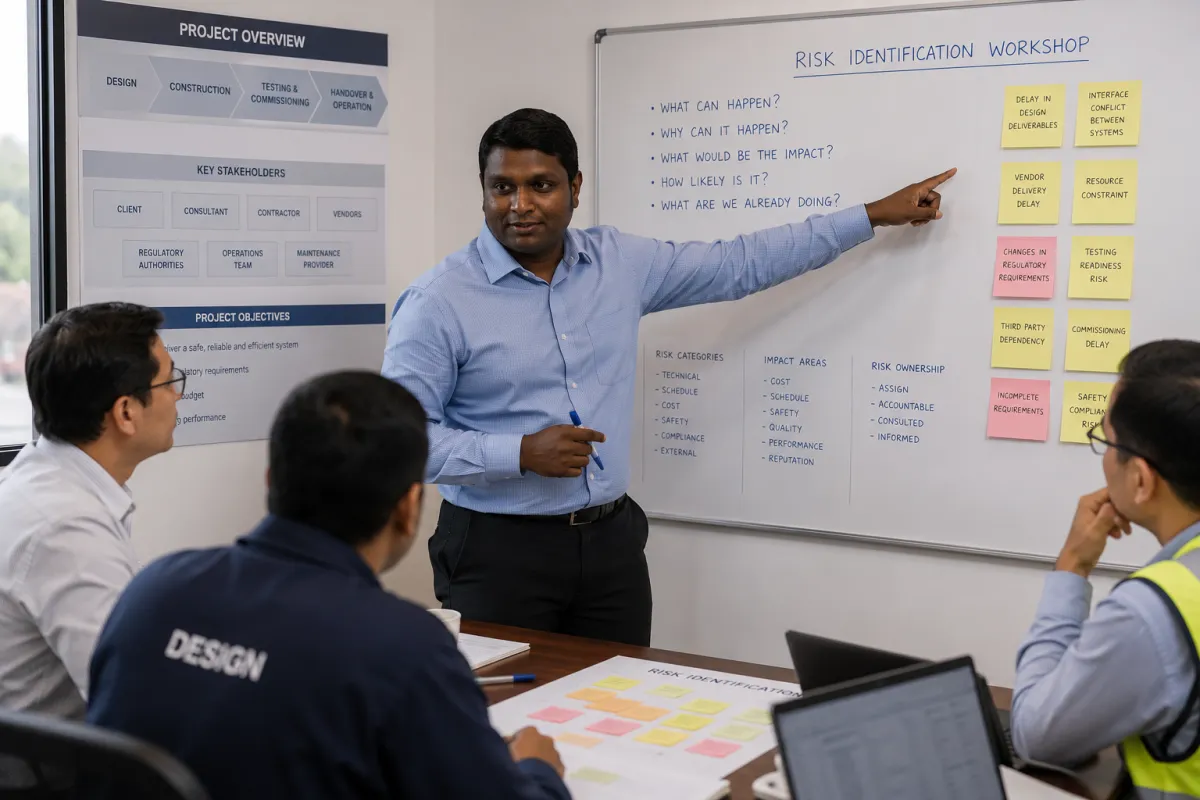
2. Identify Risks
We work with project teams and stakeholders to identify threats and opportunities that may affect safety, cost, schedule, quality, performance, compliance, operations, or stakeholder acceptance.
The aim is not to create a long list of risks. The aim is to reveal the uncertainties that matter.
Outcome: Early Visibility of What Could Affect Project Success
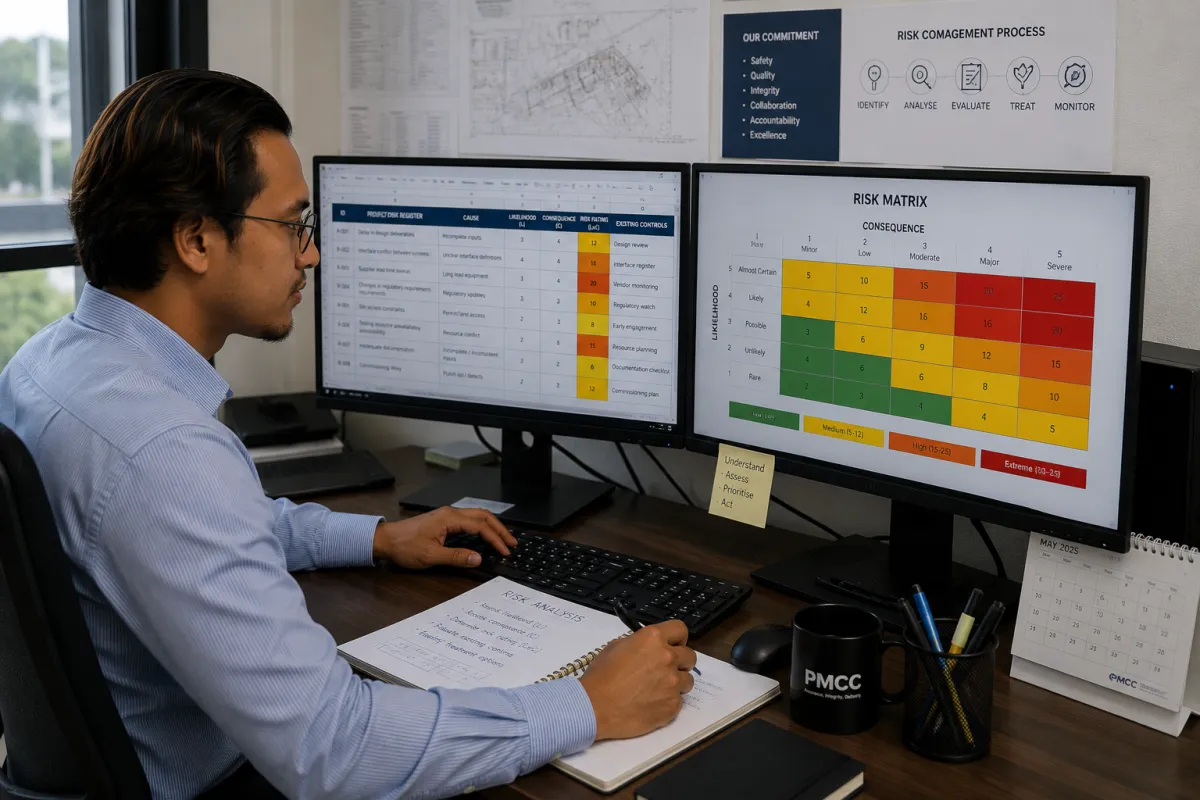
3. Analyse Risks
We assess causes, consequences, existing controls, likelihood, impact, and exposure.
This allows the project team to understand not only what the risk is, but why it exists, how it may develop, and what level of control is already in place.
Outcome: Understand Which Risks Matter Most
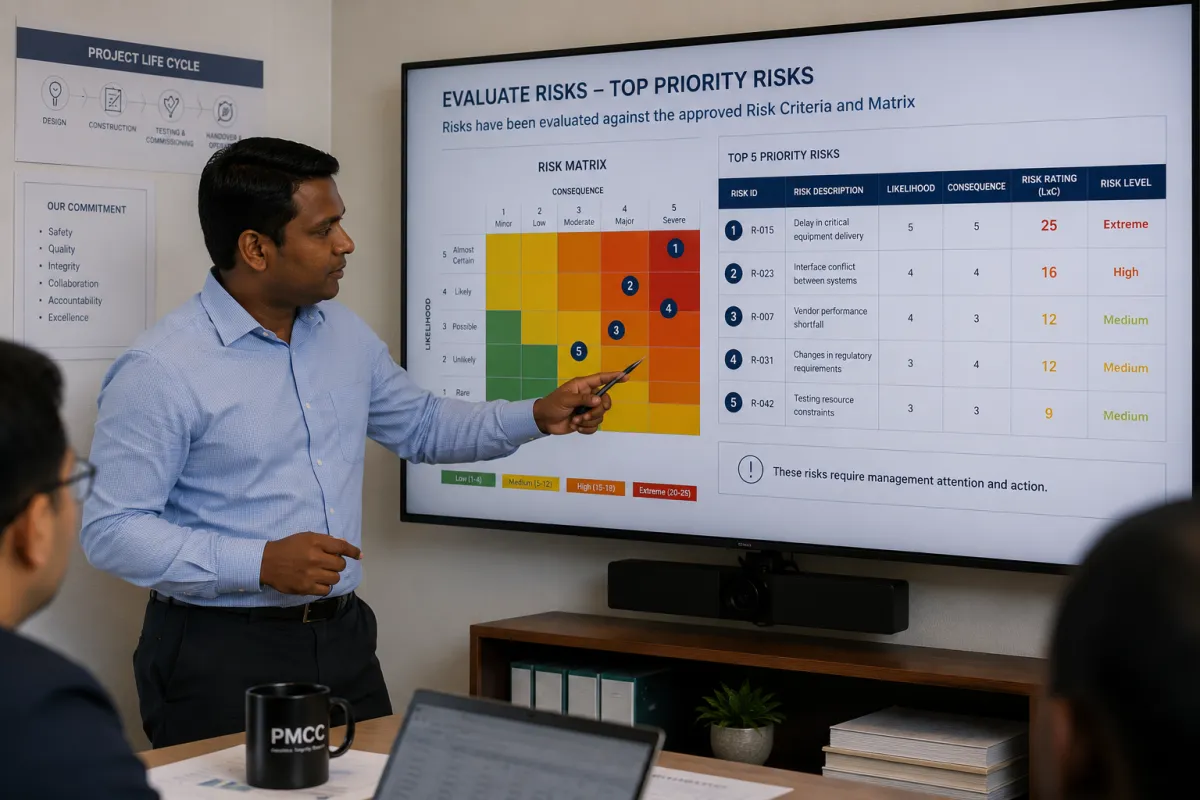
4. Evaluate Risks
We prioritise risks against agreed criteria so that attention is focused where it is most needed.
This supports better escalation, clearer governance, and more disciplined decision-making.
Outcome: Prioritised Risks That Drive Action
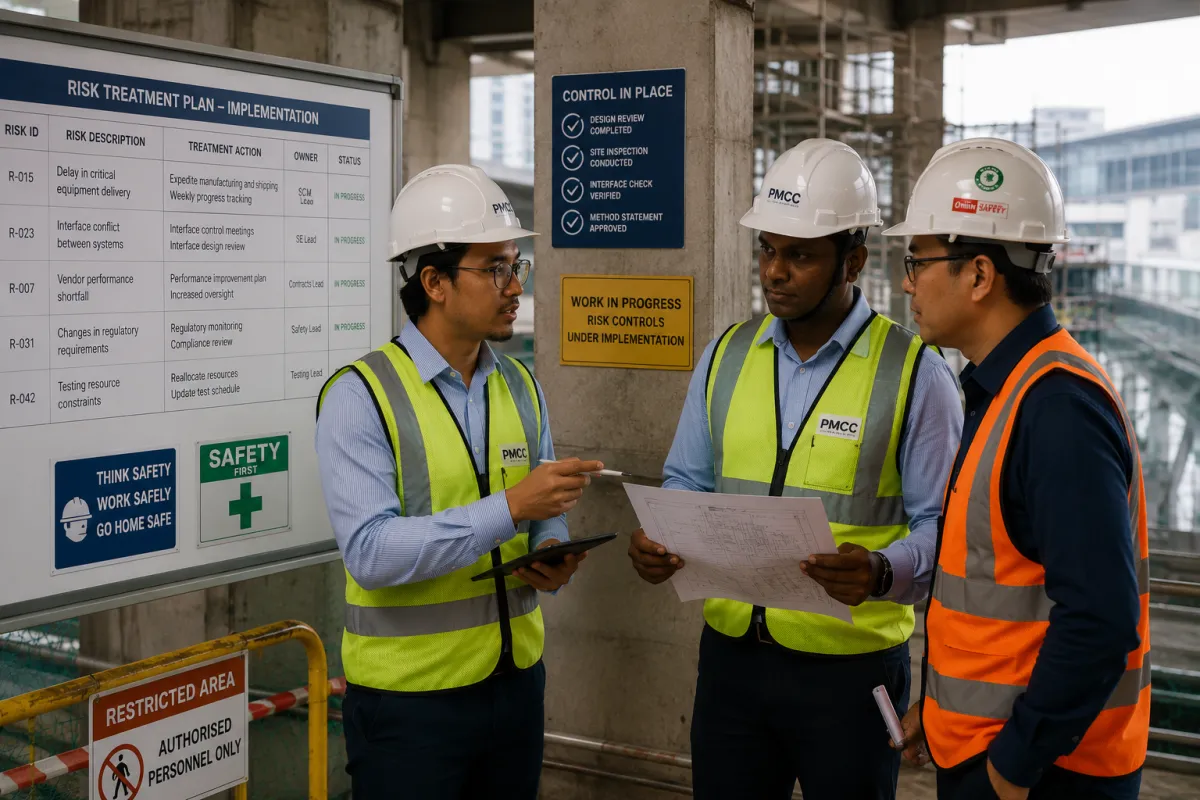
5. Treat Risks
We define appropriate treatment actions, assign owners, set target dates, and establish residual risk expectations.
Treatment actions are structured so they can be monitored, challenged, reviewed, and closed with evidence.
Outcome: Practical Actions That Reduce Project Exposure
6. Monitor and Review
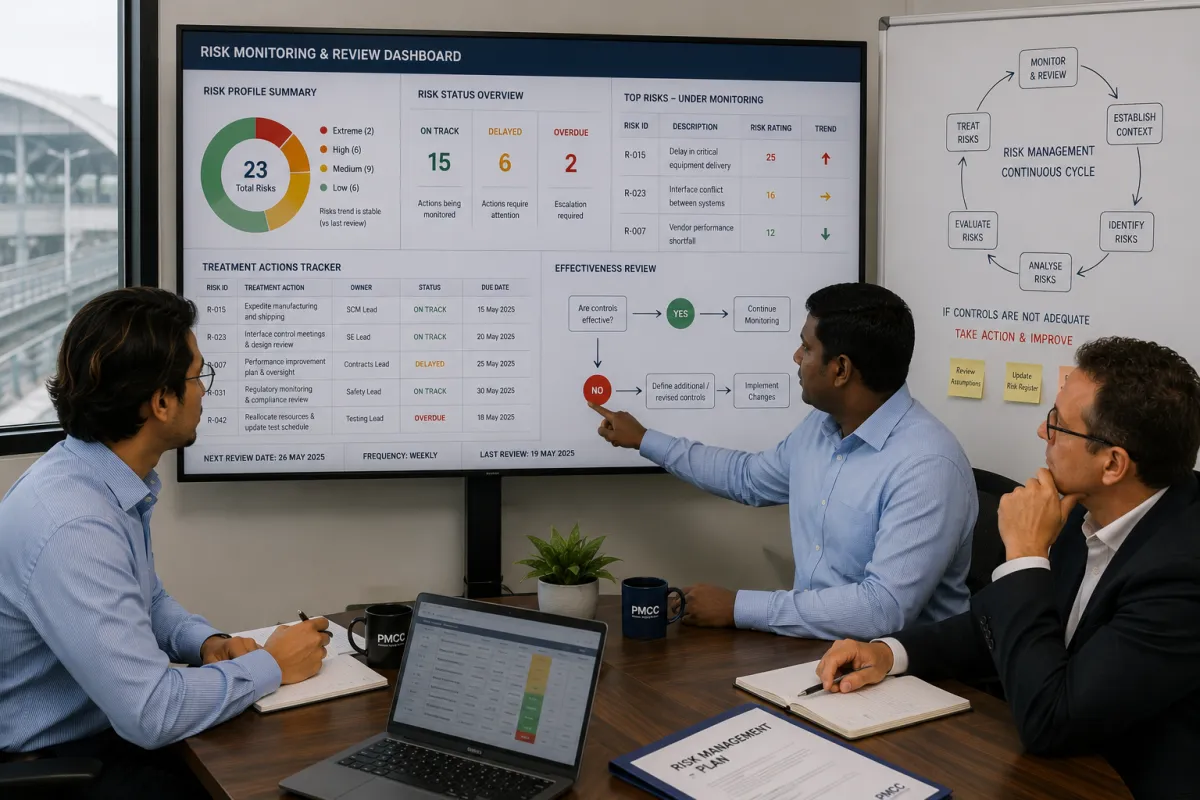
Risk is not static. PMCC supports regular review cycles to capture changing conditions, emerging risks, overdue actions, ineffective controls, and risks requiring escalation.
This keeps the risk profile current and connected to live project decisions.
Outcome: Continuous Assurance That Controls Remain Effective
7. Record and Report
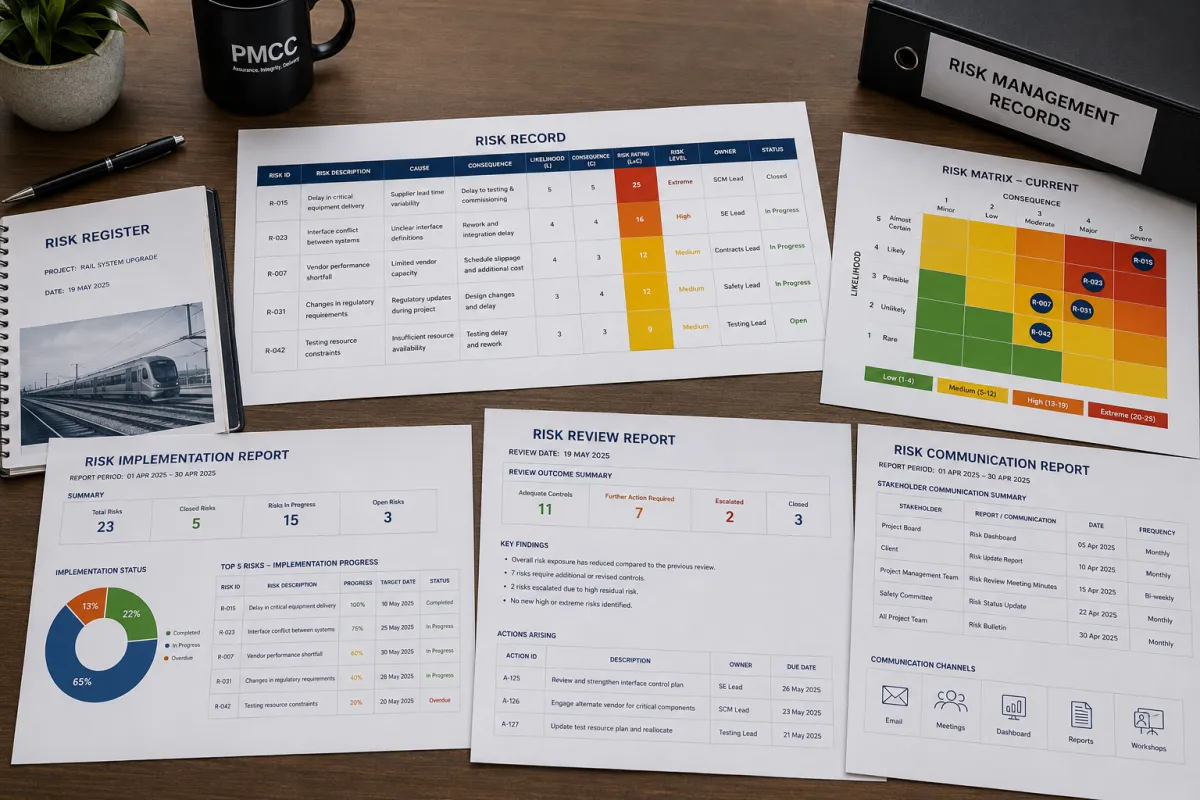
We maintain clear risk records and reporting outputs that support governance, auditability, assurance, and management review.
The result is a risk management process that is visible, traceable, and decision-ready.
Outcome: Complete Traceability and Informed Governance
PMCC's Role
PMCC helps clients turn Risk Management from a static register into an active project-control mechanism.
We structure the methodology, facilitate risk discussions, challenge assumptions, maintain traceability, track treatment actions, and support management reporting. Our role is to help ensure that risks are not merely recorded, but understood, owned, reviewed, and controlled.
For infrastructure and railway projects, this discipline is especially important. Risk Management must connect with safety assurance, requirements, interface management, verification and validation, quality, construction, testing, commissioning, and operational readiness.
PMCC brings that integration discipline.
We help clients create risk management practices that are technically credible, commercially useful, and aligned with the realities of project delivery.
Why Choose PMCC?
PMCC understands that major projects need more than risk documentation. They need risk discipline that works across the project lifecycle.
We bring a systems engineering and assurance perspective to Risk Management, helping clients connect uncertainty with project objectives, technical interfaces, assurance evidence, safety considerations, delivery constraints, and governance decisions.
This makes our approach especially valuable for complex infrastructure and railway environments where risk is rarely isolated to one discipline.
PMCC supports clients with a practical, structured, and evidence-led approach that improves visibility, strengthens accountability, and helps leadership act before risk becomes consequence.
Build Risk Discipline Into Your Project
Uncertainty cannot be eliminated. But it can be understood, prioritised, owned, and controlled.
Whether you need to establish a risk management framework, improve an existing risk register, facilitate risk workshops, strengthen reporting, or align your process with ISO 31000:2018, PMCC can help you build a disciplined approach to managing risk.
Bring structure to uncertainty.
Strengthen project control.
Make better decisions before risks become consequences.
Trusted by








FAQS
When should PMCC be engaged?
PMCC should be engaged as early as possible when assurance obligations, safety requirements, RAMS activities, interface risks, or compliance evidence need to be structured. Early involvement helps prevent fragmented documentation, unclear responsibilities, and late-stage approval issues.
Does PMCC only support railway projects?
PMCC specialises in railway and infrastructure environments where safety, compliance, interfaces, lifecycle assurance, and technical evidence are critical. Our strongest value is in complex, multi-stakeholder projects requiring disciplined assurance control.
Can PMCC support an ongoing project that already has gaps?
Yes. PMCC can review the current project position, identify assurance gaps, strengthen documentation, improve traceability, and support the development of evidence required for review, acceptance, approval, or handover.
What makes PMCC different from a general engineering consultant?
PMCC specialises in systems engineering and assurance for complex railway and infrastructure projects. We bring lifecycle discipline, technical structure, and assurance thinking into areas where clarity, compliance, traceability, and risk control are critical. Our Expert-In-The-Loop™ approach allows us to use AI-assisted workflows and structured knowledge practices to work faster and more consistently, without removing expert judgement from critical outputs. Clients work with PMCC because we provide more than engineering input. We help turn complexity into clear, controlled, decision-ready project information.
What type of deliverables can PMCC support?
PMCC can support assurance plans, safety documentation, RAMS deliverables, interface registers, requirement traceability, compliance matrices, verification evidence, testing and commissioning documentation, and handover-related assurance records.