
ENGINEERING CERTAINTY INTO COMPLEX PROJECTS
Project Intelligence for Critical Infrastructure
PMCC helps infrastructure, railway, energy, and engineering organisations deliver complex projects with confidence through expert consulting, systems assurance, project intelligence, and AI-enabled delivery.
AI-Enabled Project Delivery
Project Intelligence™ & Digital Engineering
ESG & Responsible Governance
Independent Systems Assurance
Faster, Data-Driven Decisions
Reduced Risk & Predictable Outcomes
End-to-End Lifecycle Excellence
Trusted Across ASEAN Since 2007
The Minds Behind PMCC

Engineering • AI • Systems Assurance
EXPERTISE, EVOLVED.
Engineering Confidence. Intelligent Delivery.
Since 2007, PMCC has helped infrastructure, railway, energy, and engineering organisations deliver complex projects with confidence through project management, systems engineering, assurance, integration, and technical leadership.
Today, we combine proven engineering expertise with AI-enabled delivery, intelligent workflows, and internationally aligned best practices to improve project performance, strengthen governance, and reduce delivery risk.
Every recommendation is expert-led. Every deliverable is independently reviewed. Every project is built on trust.
PMCC Intelligence™ - AI-powered Engineering & Project Intelligence
Combining engineering expertise, AI, ESG, governance, and digital workflows to deliver safer, faster, and more predictable project outcomes.
WHERE COMPLEX PROJECTS DEMAND INTELLIGENT CONTROL
Complex projects lose control when decisions slow, risks remain hidden, interfaces fragment, evidence becomes unreliable, and teams are trapped in constant firefighting. Traditional coordination is no longer enough.
PMCC combines deep project expertise with AI-enabled project intelligence to improve visibility, accelerate analysis, strengthen decisions, and identify emerging issues earlier. With experienced experts always in the loop, we help clients bring complexity, compliance, stakeholders, and operational outcomes under disciplined control.
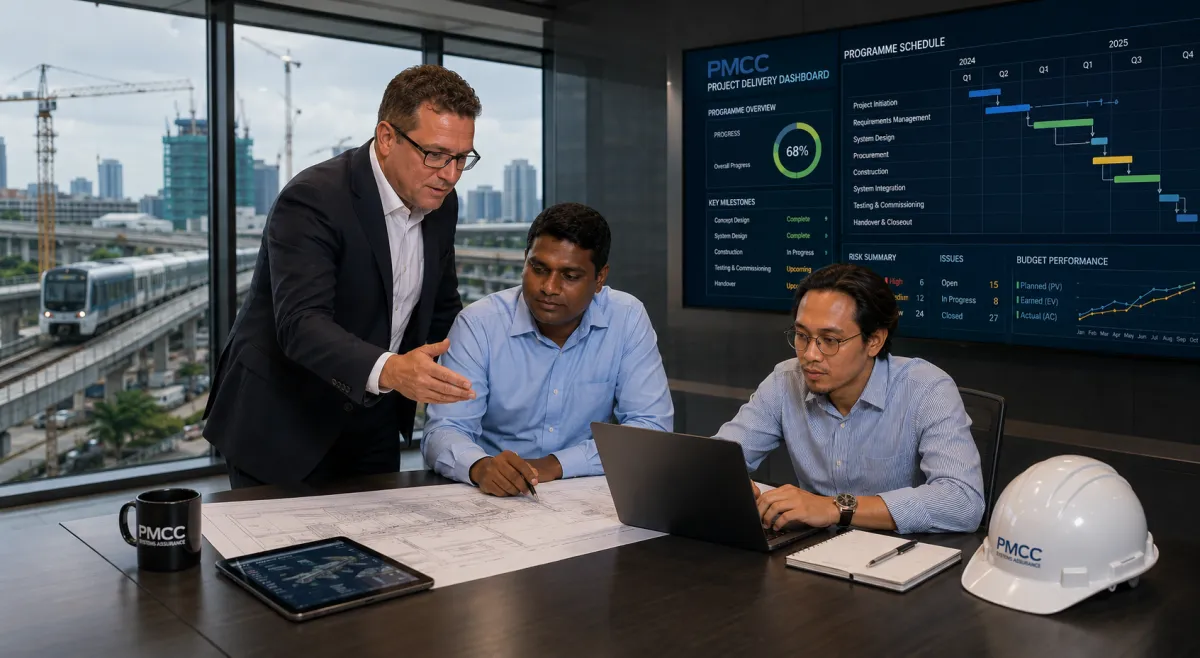
When delivery needs more than coordination.
Complex projects need structure, discipline, and leadership that can hold scope, schedule, cost, stakeholders, and decisions together. Through Project Management, Project Delivery Partner and Planning support, PMCC helps clients strengthen delivery control, improve visibility, and keep project execution aligned with the outcomes that matter.
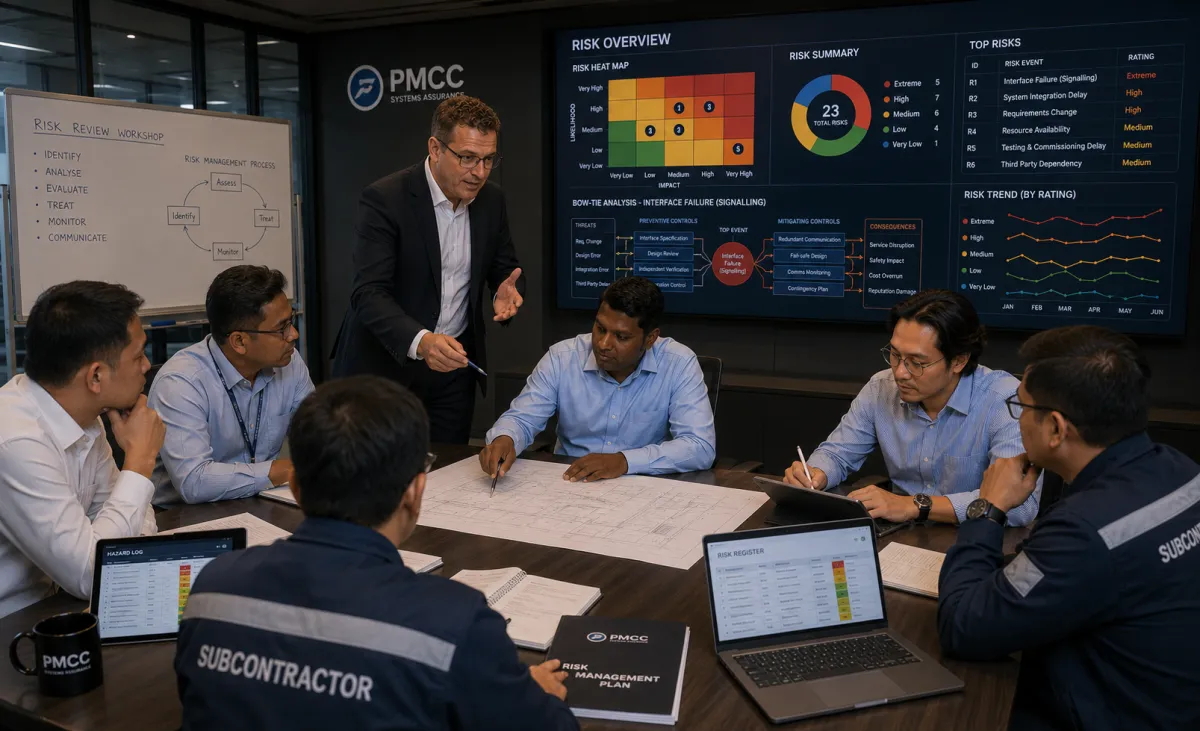
When risks are visible too late.
Risk does not become dangerous when it appears. It becomes dangerous when it is not understood early enough for leadership to act.
Through Risk Management, PMCC helps clients identify the pressures beneath the surface, strengthen risk visibility, and support better decisions before exposure becomes consequence.
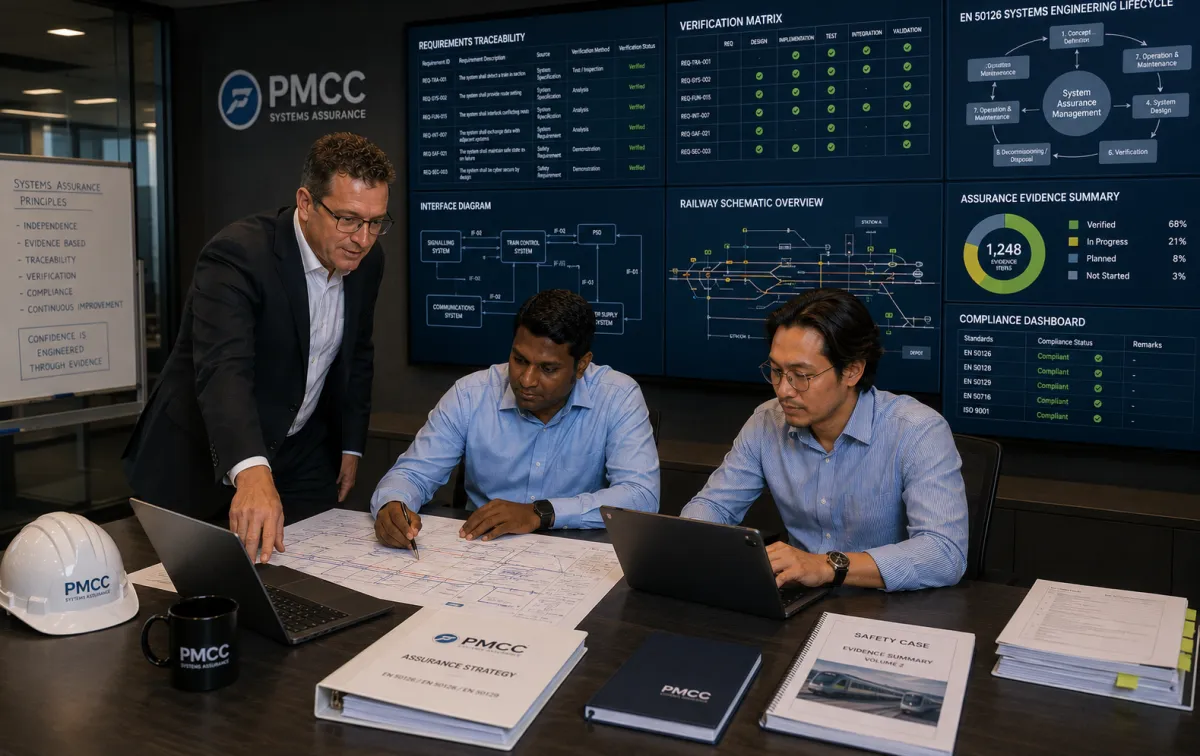
When assurance, requirements, and acceptance evidence must stand up to scrutiny.
In complex projects, compliance cannot be treated as paperwork. Requirements, assurance evidence, safety arguments, and acceptance readiness must be managed with discipline from the start.
Through Systems Assurance and Requirements Management, PMCC helps clients strengthen traceability, assurance confidence, and lifecycle control where safety, reliability, compliance, and acceptance matter.
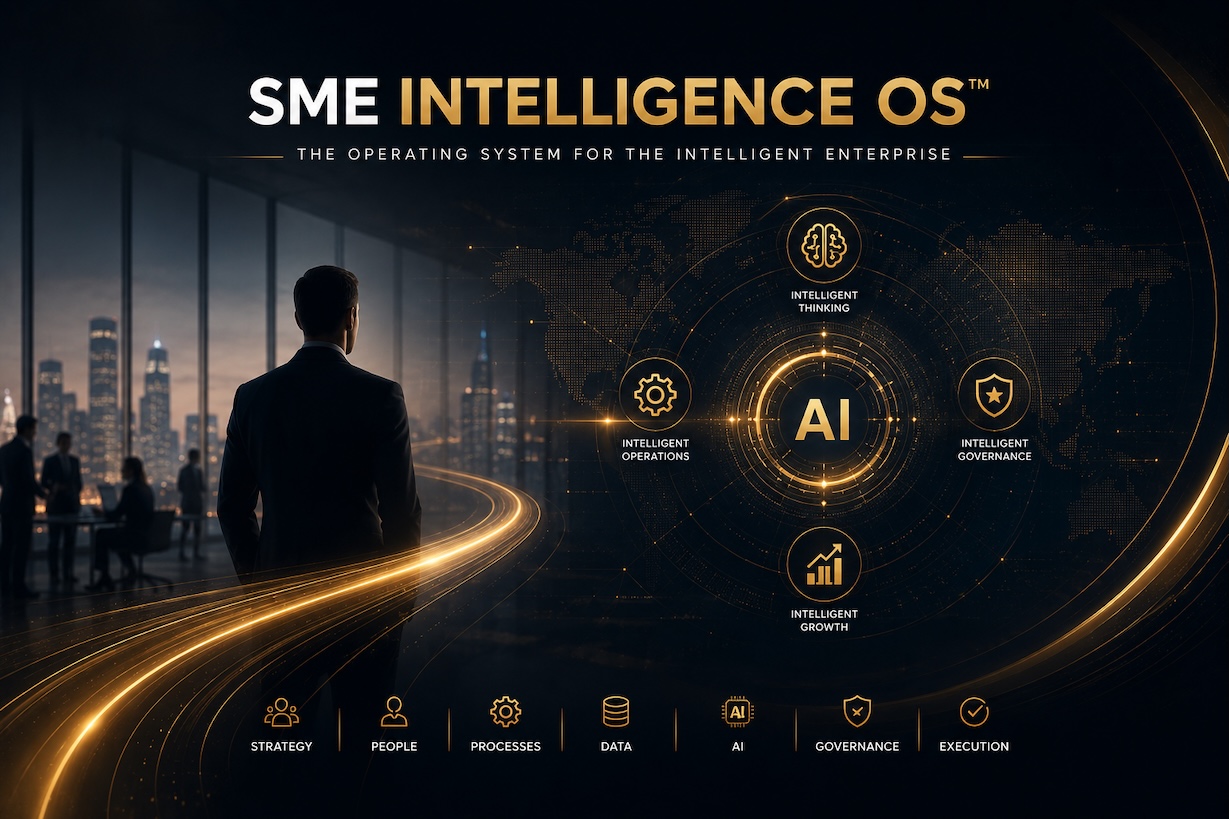
AI Transformation, ESG Readiness and Responsible Governance
SME Intelligence OS™ helps SMEs move beyond random AI tools and disconnected ESG initiatives.
It integrates strategy, people, processes, data, AI, governance and ESG into one practical transformation framework designed to improve productivity, strengthen oversight and create measurable business value.
Through executive briefings, transformation labs and board-level advisory, PMCC helps leadership teams become more intelligent, resilient and future-ready.
Best suited for: SMEs, Boards, CEOs and leadership teams preparing for AI-enabled growth, ESG expectations and stronger governance.
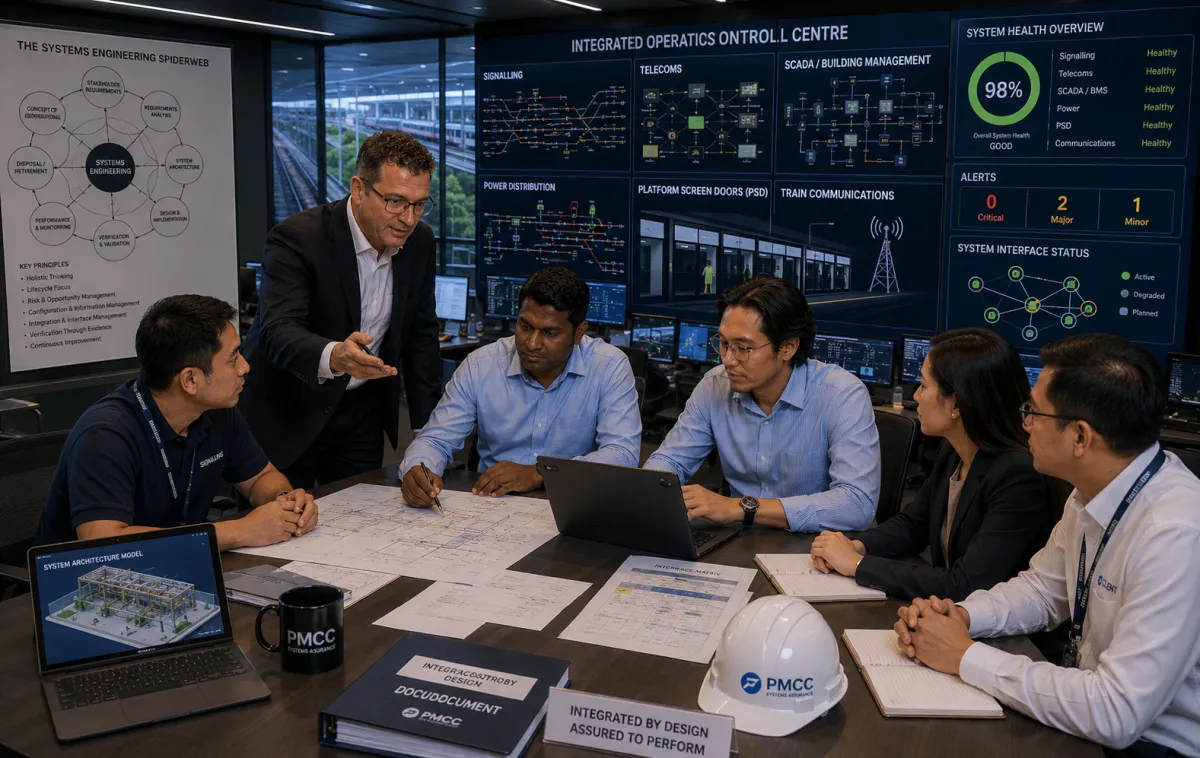
When systems, interfaces, and stakeholders stop moving as one.
Integration risk often appears late, but it is created much earlier through unclear interfaces, disconnected disciplines, weak requirements alignment, and fragmented technical decisions.
Through Systems Engineering and Systems Integration, PMCC helps clients improve technical alignment across systems, contractors, stakeholders, and delivery phases.
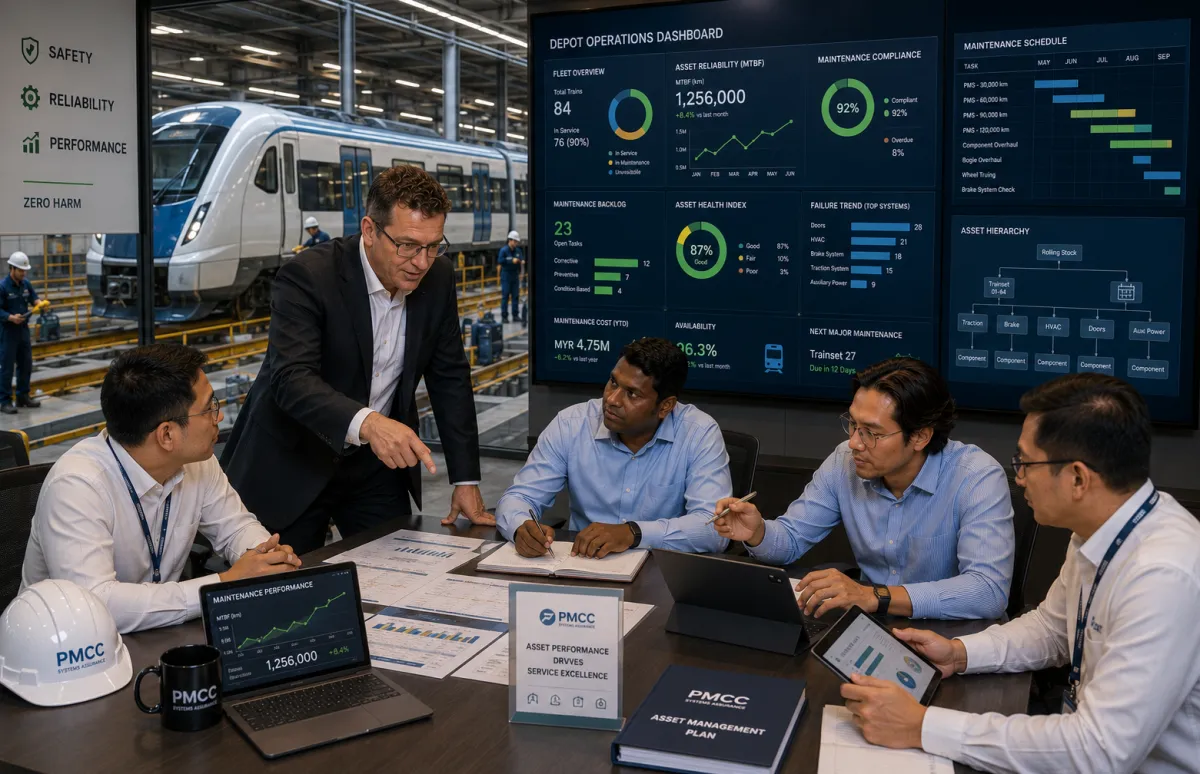
When operations are running, but performance can be stronger.
O&M challenges are often not caused by the people doing the work. They come from outdated processes, unclear workflows, weak data visibility, inefficient handovers, and maintenance practices that no longer match operational demand.
PMCC supports Operations and Maintenance optimisation by helping clients review, improve, and strengthen existing O&M processes without taking over the operation itself.
When Projects Lose Control, Leadership Needs Independent Intelligence.
Some projects do not need another layer of reporting. They need an independent view of what is really happening. Project Mentors™ is PMCC’s executive intervention practice for complex programmes facing delivery pressure, governance challenges or strategic uncertainty.
We conduct independent project intelligence reviews, governance assessments, forensic project investigations, delay and disruption analysis, recovery planning and executive advisory to uncover root causes, establish the facts and restore delivery confidence.
Our role is not to replace the project team. We provide sponsors, boards and executive leadership with the clarity, evidence and strategic direction needed to make informed decisions, reduce risk and bring critical projects back under control.
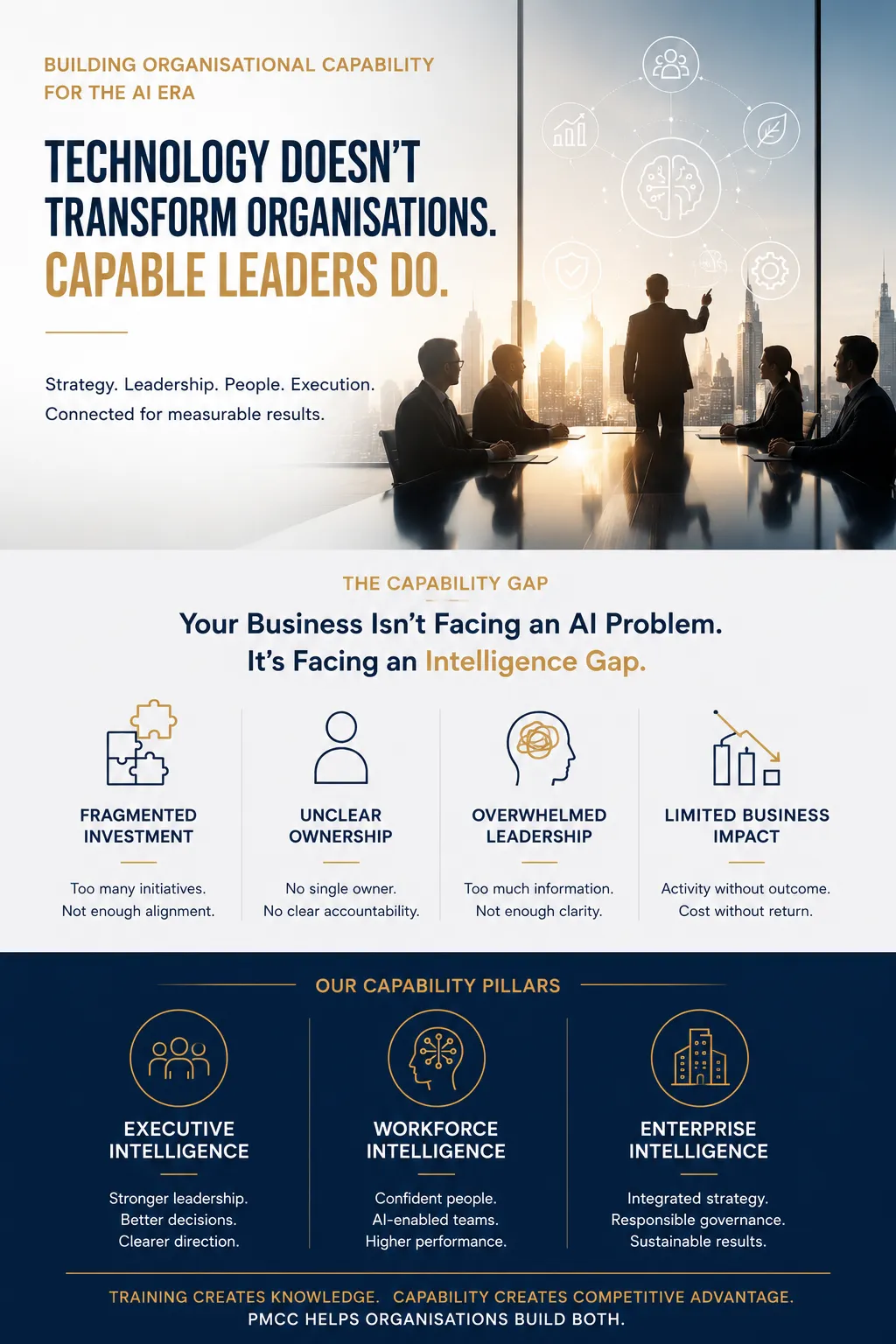
Building the Human Capability Behind Intelligent Transformation
Artificial Intelligence is transforming how organisations operate, but sustainable success depends on the capability of the people leading the transformation.
PMCC Learning & Development helps boards, executives and professionals develop the judgement, leadership, strategic thinking and practical skills required to turn AI into measurable business value. Every engagement is designed around your organisation’s strategy, maturity and business objectives, not a catalogue of standard courses.
We combine executive advisory, AI literacy, systems thinking and real-world implementation experience into tailored programmes that strengthen leadership, improve workforce capability, accelerate organisational transformation and support successful execution.
We don’t measure success by training delivered. We measure it by capability built, decisions improved and business results achieved.
EXPERT-LED. AI-ENABLED. ASSURANCE-DRIVEN.
PMCC integrates advanced digital tools and AI-enabled workflows to improve the speed, structure, consistency, and intelligence of technical delivery. Our position is uncompromising: technology strengthens the work, but experts remain accountable for every outcome.
Through our Expert-in-the-Loop™ approach, professional judgement, verification, contextual review, and disciplined assurance remain embedded in every critical output. This allows us to work faster and produce stronger results without weakening the engineering rigour, governance, and traceability required for complex railway, infrastructure, and strategic projects.
PMCC also captures, structures, and reuses project knowledge to improve continuity, reduce rework, accelerate decision-making, and preserve critical intelligence across the project lifecycle. For clients, this means clearer evidence, stronger documentation, earlier risk visibility, better-informed decisions, and deliverables produced with speed, discipline, and professional control.
Complex projects no longer need to choose between speed and certainty.
Partner with PMCC to achieve both.
Meet the Experts-In-The-Loop
Assurance is strongest when expertise remains close to every critical decision.
Our Expert-in-the-Loop approach brings experienced railway and systems assurance professionals directly into the review, challenge and validation process—ensuring that project decisions are technically sound, evidence-based and aligned with lifecycle obligations.

Peter Wyss
MD


Dinie Amani
SA & RM Expert

Brian Immanuel
SE & SI Expert
Trusted by














THE PROJECT QUESTIONS
LEADERS CAN NO LONGER IGNORE
Complex projects do not lose control overnight. They deteriorate through delayed decisions, fragmented information, unmanaged interfaces, weak assurance, repeated rework, and risks that remain invisible until they become expensive. The real question is no longer whether projects should become more intelligent. It is whether leadership acts before complexity turns into delay, claims, operational failure, or reputational damage.
1. Do we have real project control, or only the appearance of control?
Reports, meetings, and dashboards do not automatically create control. Real control exists only when scope, schedule, cost, risk, interfaces, decisions, assurance evidence, and stakeholder obligations are connected into one reliable delivery picture.
Where PMCC can help:
PMCC reviews the complete project control environment, identifies gaps and contradictions, and establishes integrated governance, reporting, escalation, and decision mechanisms so leadership can act on facts rather than assumptions.
2. Are we using AI to improve delivery, or simply adding another disconnected tool?
AI creates value when it improves how the project analyses information, detects risk, manages knowledge, produces evidence, and supports decisions. Adding software without redesigning the delivery process merely creates another system that teams must feed.
Where PMCC can help:
PMCC embeds ISO/IEC 42001-aligned, AI-enabled workflows into practical project activities such as reporting, schedule review, risk analysis, requirements management, document control, knowledge retrieval, and decision support, with experienced experts remaining accountable for every output.
3. Can we see delays and emerging risks before they affect the critical path?
By the time a delay appears in the monthly report, the opportunity to prevent it may already be gone. Intelligent project management must connect approvals, access, procurement, interfaces, design maturity, authority decisions, testing readiness, and long-lead items to identify emerging threats early.
Where PMCC can help:
PMCC performs programme, dependency, and early-warning reviews to expose critical constraints, trigger points, and external dependencies, then converts them into targeted mitigation, recovery, and escalation actions.
4. Are project interfaces actively controlled, or merely recorded in a register?
Most failures in complex projects occur between disciplines, packages, contractors, authorities, systems, and operational stakeholders. An interface is not managed until ownership, inputs, outputs, dates, acceptance criteria, and evidence are clearly defined and closed.
Where PMCC can help:
PMCC establishes an integrated interface management framework that links technical interfaces to requirements, schedules, risks, testing, approvals, and handover obligations, ensuring that dependencies are resolved rather than repeatedly discussed.
5. Can we demonstrate that the system is safe, reliable, compliant, and ready for operation?
Progress percentages and completed installations do not prove operational readiness. Projects need structured evidence that requirements have been verified, hazards controlled, RAMS targets addressed, systems integrated, tests completed, and acceptance conditions fulfilled.
Where PMCC can help:
PMCC develops and strengthens systems assurance, RAMS, safety, verification and validation, requirements traceability, compliance matrices, testing evidence, readiness reviews, and safety-case documentation from design through final acceptance.
6. Are risk registers influencing decisions, or merely satisfying governance requirements?
A long risk register is not evidence of effective risk management. Risks must be prioritised, quantified where practical, assigned to accountable owners, linked to programme consequences, and escalated before they become claims, delays, or operational failures.
Where PMCC can help:
PMCC converts risk management into an active decision process by connecting risks to schedule, cost, interfaces, contracts, assurance obligations, and mitigation actions, giving management a clear view of what requires immediate intervention.
7. Is our project information producing intelligence, or just more administration?
Complex projects generate thousands of documents, emails, reports, minutes, schedules, drawings, and registers. Without structure, critical knowledge becomes difficult to retrieve, inconsistencies remain hidden, and teams repeatedly analyse the same issues.
Where PMCC can help:
PMCC structures project information into usable project intelligence, using expert review and AI-assisted analysis to identify missing evidence, conflicting information, overdue decisions, recurring issues, and priority actions.

FOLLOW US


